HakkerBlog
Tag: rant
-
Comments Don't Belong on Blogs Actually
A response to the discussion in general, but primarily based on The Case For Comments
Comments can take the role of truth sayer
I have noticed a lot of people when they are presented with an opinion they are unsure if they agree with, they will impulsively check the comments to see if they should agree with it. Without comments, the reader is forced to actually think about what they think about the opinions expressed before them — No one tells them how to think.
@grok what do you think about this?
Comments are just noise
I can agree with the above mentioned posts that:
This amount of preamble can feel like overkill in a lot of situations. For example, [...], cracking a joke, [...], sometimes a comment is the best fit.
For a quick joke or a goof, a comment field is the best fit. My boring opinion on that is however: What value does that bring? More often than not, I feel like it is just noise.
Speed is bad actually
So the first reason why I believe comments don't belong on blogs is that they enable fast quips and thoughtless opinions. Some people do hold grounded and tested opinions, but we are on the internet. Tribalism and righteousness run rife, and debunking the oposition tends to be more important than actually adjusting your own opinion.
Forcing the user to slow down by composing a mail will both encourage them to properly think about and compose their opinions, and also hamper bad actors who are not interested in having a actual discussion.
Thoughts and opinions take time, unlike comments.
You are now entering Opinion Land
Or well this entire post is an opinion piece, don' worry 'bout it
We need to detox from engagement culture
Our modern web landscape is fundamentally built on ranking eachother based on engagement. Who got the most clicks, hits, comments, likes, viwes, etc.
Algoritms push content that drives the most engagement, we intrinsically agree with posts that have a lot of engagement, and we constantly chase it to fulfil our own ego.
By constantly chasing engagement, we need to dumb down our opinions to be as agreeable as possible. When you start comparing hom many comments, views and likes your posts get, you naturally try to create content that will arcue more engagement. This rarely leads to more thoughtful and valueable content.
I'm not here to defend myself
I use this blog to express my opinions and thoughts, but I have no desire to defend them. If you don't agree with what I say, you are free to leave, or atleast live with that we don't share opinions in that specific area. You are more than welcome to send me a mail, if you wish to discuss and share ideas, but if you just want to tell me I am wrong, then a non-public email is a lot easier and convient to ignore than a comment.
You are not here to show your righteousness
With comments being public, you have a interest in sharing a opinion that not only appeals to the author, but also other readers. Having to adjust your writing based on what other readers think about your opinion at a glance does not add value.
Also, having your name attached to comments will make you think about how it would change your image, and that doesnt help you make thoughtful and arguments that everyone might not agree with.
To Recap
I welcome discussions and thoughs on my posts, however I expect you to atleast put down the effort to compose a mail. If your thought wasn't worth the minute to write a mail, is it even worthwhile for me to read?
Comments are also a venue for engagement, and any type of measurable engagement is bad.
A blog should (in my opinion) mirror a public talk at a venue, with personal one-on-one discussions coming after. If your are looking for a experience more like a soapbox discussion in a public plaza, you are looking for a forum instead (those still exist you know?)
Also, this is all opinions, if your blog has comments, that's your choice. You have your own opinions and standpoints and they are also valid.
(PS. have you reflected on that the internet and irl meaning of comments are actually mostly the same? Like, I have always felt like the comment section under a video, and commenting about someones appearance in person are fundamentally different, but both are just, well, comment about someone/something. Might just be my bilingual ass being confused)
28-01-2026 -
Meaningfulness
I have met people from all walks of life. I have met millionares and people living on benefits. I have met people who are doing fine, and people in deep depressions. I have met people that grew up in a strict household, and I have met people who had to raise themselves.
However, I have found one primary way to gauge how happy people are.
Are they doing something that they consider meaningful?
It doesn't have to be their main source of income, it can just be a hobby, but it has to meaningful for them.
Boredom
For us youngsters that grew up in the time of the internet, we have been very protected from boredom. We have always had access to stimuli. Even if you didn't have a
brick of doomsmartphone, you could hamper boredom with a dumb phone. While waiting for the bus, you could play a game of snake.Humans are hard wired to find stimuli, in the same way we are hard wired to eat energy dense food, and hard wired to try to fit in. However, in todays post-scarcity, these forces aren't as helpful anymore — actually they tend to be counter productive.
Can you imagine yourself sitting in a silent room, with no stimuli, for an hour? This shouldn'te be a insurmountable task, but it still seems so. This isn't your fault, but you can do something about it. Your brain isn't broken.
You could just as well imagine if you were a nudist for a year. Wearing clothes after that would be really weird, uncomfortable and itchy. But in no way would it be insurmountable to start wearing clothes again?
Happiness
But who cares about boredom? Boredom is something negative, and should be avoided. Even if scrolling can't give you happiness, it can still hamper boredom, and that is comfortable.
Now I'm not going to hype up boredom being a cure-all, other people have done that and have more data to prove it. However, I would like to point out that neither boredom nor mindless scrolling gives you any meaning. However, boredom gives some you agency and motivation to do something meaningful. When you are bored, you will find motivation to work on your hobbies. When you are bored, you suddenly have a lot of time to use. Scrolling provides neither of these.
What is meaningful then?
Well that depends on you as a person. My political value consider local resiliency and keeping money local as good things. Hence, I value local art and crafts. A relative of mine finds meaning in painting, and I can proudly say that many of their paintings live on my walls.
I find value in doing things myself, even if they aren't great when compared to others. I paint with hand-me-downs and Ali Express brushes. I am proud of some of my paintings, even if they are nowhere near what my relative makes. But I find value in it, because the result isnt what is important, I guess it's the feeling of improving myself that drives me, along with a strong leniency towards myself. Doing something poorly is infinetly better than not doing it at all.
I guess that I am in a financially stable enough position that most of my meaning comes from sharing and participating in the human experience. I love reading blogs, instead of social media. I specifically find the lack of comments a necessary limitation, quick discussions and fast quips arent meaningful.
Here is a quickfire list of other things I have done that I felt was meaningful
- (Failing to) Make soap from scratch
- Produce my own firewood
- Every now and then, cook something more impressive
- Keep my old 60's family sedan rolling
- Supporting local artisans
- Code on my own hobby projects, however small and janky they may be
- Join the local volunteer firebrigade
Quality of life only gets you so far
To be happy, you need your base needs fulfilled. However, after that, you quickly fall down the "status spiral". Most of the things I consider meaningful are cheap, and generally don't use too much time. Whenever I see people who actually use social media, especially those who are very invested in it, it seems like everything they strive for is to improve their image.
Modern social media promotes comparing yourself to others. When you try something new, comparing yourself to others is a surefire way to fail, especially if you compare yourself to people who actually post it on social media.
Modern social media also promotes the mindless consumerism we struggle with today. Remind yourself that your status, image and wealth isnt what gives you meaning, it simply hampers your boredom and desire for meaning. Go achieve something meaningful instead!
20-01-2026 -
A Boring Life is a Exciting Life
What is happiness?
Finland often tops the world happiness charts, which most people probably find weird. How come a country with a middling GDP, in a poor climate, no oil, dark winters, etc, is so happy?
There is a misconception about happiness. Think of a happy person, you are thinking of a smiling person, perhaps a laughing person — But that is not happiness. Happiness is something deeper, being able to fulfill your life goals, being able to live without stress and strife, to not be afraid.
That is why the happiest countries seem so boring. Resdents there aren't stressing about keeping a roof over their head, food on the table or having the time to study what they desire.
Short boomer rant
Did you know that almost half of Americans earning over 100 000$ are living paycheck to paycheck? You may think that if you just had another 500$ a month to play with, you would finally realize you dreams. But that is statistically not true, you are always just around the corner of earning enough — always.
I don't want to become a boomer, telling the youngsters to live within their means while they barely afford food — but...
Did you know you don't need an expensive car? A beater from the 90's will work just as well at driving the speed limit as a modern car. Also, debt sucks. If you can afford a beater today, you can put away some money that would have gone to car repayments to actually save for a new car. And if you struggle with holding on to savings, you aren't the type of person that should take debt.
What is the money for anyway?
What are the big, expensive purchases we feel like we deserve? Well a computer or a laptop, a mobile phone and probably a TV. And the thing is, there is merit to this. Try holding a job or doing your taxes without a computer. Try to have a social life without a phone. It's basically imposible in todays landscape.
What I want you to think about is what caliber of tech/gadgets/other expensive items you need. What do you find meaningful? What do you need to achieve these things that you consider meaningful? You can get by or atleast started for relatively very little these days.
I'm strugling to stay on topic, I'll write another post about achieving meaning...
But I'll leave you with this. Avoid unnecessary debt, avoid unnecessary risks, embrace boring and safe choices. Avoid comparing yourself, there is always someone richer, prettier, better, higher status, and there is always someone who seems happier. You will never climb to the top, the ladder just gets taller.
You can realize your passions today, you don't need to overdo it.
19-01-2026 -
Stop Being a Serf
Followup on The AI Engame by Adam Something
Something that has bugged me for a long time is how accepting people are for monthly fees.
I hate monthly fees, I have never understood how people seem to think its "cheaper". In theory, there is a market for renting or services, for example, I pay a monthly fee for internet and electricity, because its a ongoing service. Back in the day of rental movies, if you were only to watch that movie once, why wouldn't you rent it?
I don't have anything against services where you actually have a continual service, like internet access, a training program, podcasts, etc. I also dont have problems with renting and leasing things, where you get the same value, for a lower cost, at the end of its usefulness for you, for example renting a scissor lift, tools, transit vans, etc.
What actually annoys me is how people don't seem to understand the value of owning, primarilly that you don't need to pay for it anymore, secondarily that no one will take it back. And the thing is, you can still buy things. For the cost of Spotify today, you can buy one or two albums — every month. How many new albumns do you listen to every year? Would it be cheaper to just buy them, rather than paying for whatever music streaming service you use? Probably, so why do you keep paying for the streaming service?
Now that isnt the great part of owning, you might save a couple of bucks per month, but what if you were to stop paying? You would have nothing, you have paid hundereds (maybe even thousands) of dollars for music, yet now you have nothing, but you could have so much.
This doesnt only apply to music, think of all the different services that charges you every month, or the convinience services that you use when you can't be bothered to do routine tasks. After everything is done and payed for, what does it leave you with?
Sure, you can afford it.
Money comes, money goes. They say
Sure, money does go, but you can never be too sure money comes...
15-01-2026 -
I Will Not Participate in the Rat Race
Warning, this ended up as mostly me rambling...
What is the purpose of life anyway?
If you've taken part in online discussions, particularly tech related forums, you've probably noticed that it's expected that if you want a fulfilling life — you need to become rich.
Here is how to become a millionare by investing
How my startup earned millions
super-ai.dev raised 50 million in VC funding
Being a worker means being a sheep, real life is enjoyed by entrepenours. Grinding the 996 is worth it, because why would you want to be sitting at home if you don't have a shitton of money.
Create a start-up, blitzscale it, raise investor money and sell it before it collapses — repeat.
Let's roll it back
Let me be abstract, what is the purpose of "work"? Why are you going to the same place, doing the same thing, the same hours, day after day? Because it's efficient.
I like to see it as a scale from 0 - 100, where 0 is you do absolutely everything yourself. You are a literal caveman in the woods — building a shack with sticks and rocks. By 100, the only thing you do is the job you specialize in. Someone else built your home, grew your food, drove you to work, cut the food on your plate, wiped your ass. Most of us fall somewhere in between, we like to cook our own meals, however with ingridients that someone else provided, we like to program using compilers someone else has made. Some of us like to DIY, other people call handymen and craftspeople. That's fine, that is how modern society is structured.
Grug
Imagine a tribe, where everyone fends for themselves, they're all at 0 on the scale. Everyone spends all their time to achieve their baseline life quality. However, one person decides to specialize, let's call him Grug.
Grug decides to focus on producing more firewood, which he trades with his other tribespeople in exchange for food and shelter. Not having to worry as much about food and shelter frees up time to produce more firewood, and having more time allows Grug to become more experienced and work more efficiently. This tribe of 16 people, who used to spend an hour a day collecting firewood, is now supplied buy Grug, who can provide everyone with firewood in just 12 hours. Grug in exchange is provided the resources to achieve his normal baseline life quality, and now has 4 hours that he can use for what he wants.
Perhaps he will use this time to find a better rock for his axe, allowing him to work even more efficiently. Perhaps he will spend this time collecting resources to get a bigger shack. Perhaps he will even just relax, and you know — enjoy life.
Grug has moved up the scale, and has more time to enjoy life, or enjoy a better quality of life.
Kevin
Now imagine Kevin, he works in Nos Langeles for a tech startup. He works twelve hours a day, six days a week, and he earns bank. Unlike Grug, Kevin doesn't cook his own food, he is able to pay a chef to cook it for him. Kevin doesn't drive to work, he pays for a chauffeur so he can clock in some extra hours on the ride to work. Kevin doesn't watch movies, he pays someone else to do that and tell him Kevin if he enjoyed the movie or not.
Kevin doesn't wipe his own ass..You probably understand where I'm going with this. The short abstract of this is that.
- The more you specialize, the more you can achieve — and the more you can buy.
- However, the more you specialize, the less you live.
There is a point of diminshing returns on specialization.
- I am currently writing this from a warm building, built by an expert. In return, I'm willing to specialize in something myself (personally, software development)
- You may want to hire a handyman to build a fence, personally I would like to do that myself. However, that is subjective and you have a choice.
- Neither of us want's to work so much that we can afford a mansion, which we can't live in because we are to busy working.
Please refer to this completely real graph with real values
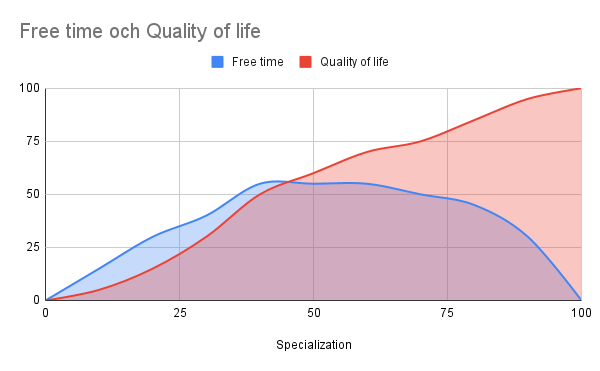 First you gain free time and quality of life, however eventually your free time plateous, but quality of life keeps increasing. The further you go however, the less free time you have. You may have everything you could dream of, but you don't have time live it.
Take a moment to reflect on yourself, your friends and people you know — where they end up on this scale.
That friend that works part time and lives in a small apartment. While they don't spend a lot of time at work, they instead have to spend time cooking their own food with raw ingridents. They have to hand wash their dishes, because they can't afford a dishwasher.
That relative that always drives expensive cars, but never shows up to get-togethers. That old neighbour that is always home, but is always fixing something.
I don't want to be rich
I'm not going to found my own AI start-up. I'm not going to invest in the orphan crushing machine. I'm not going to work weekends to buy a new car.
I'm going to work my 7,5 hours a day, 5 times a week. I'm going to take the bus, so I can spend less time driving. I'm going to live in my house out in the country, where I can thrive.
When I have payed of my mortage, I will probably work 80% instead, I don't want the money,
I'm content. I'm happy.
02-01-2026