HakkerBlog
Tag: indie
-
Why You Are Scared Of Posting
You know the feeling of writing (or creating) something, and it's just... not that good?
Here you are, after just having put down a decent amount of effort, and it's not as thoughtful as you hoped it would be. Perhaps it's just better not post this publically, leave it uncreated.
I want you to note a dissonance here. Where you judge your work based on the amount of effort you have put in, is completely different from a reader. You have just spent time and active effort for a while, but the reader won't have to put down that effort. I am a chronic skimmer, I can only read a couple of words before my eyes start to wander of, looking for keywords to figure out the meaning instead of actually reading.
The reader (me) will only have to at most read it, and at least skim through it. We won't judge you on the quality of your work based on how much effort you put in, only on how valueable it is against to how much effort it was to consume — and it's trivial to consume content. Only when you have created something that will leave me more unhappy, than before I saw it, you should perhaps avoid posting it. Like AI slop :)
02-03-2026 -
You Should Have A RSS Feed
You know what we all hate these days? Algorithms. Algorithms that decide what we should see, what we should feel, what we should interact with. The concept of using a algoritm to recommend content isn't bad per se, however it's what these algoritms promote that is the problem. It's more often than not something that promotes interaction by making you angry, keeping you on the app longer to consume more ads.
But how else do we find content on the net? You've read the title, you know that the answer is by curating it yourself. First of all you can subscribe to blogs, not that you need to read them all, most RSS readers allowss you to just mark them as read if you don't find the topic interesting.
Regarding discovery, did you know that you can follow hastags? Not just on Xitter or Mastodon, for blogs you can use octothorpes(which I also use, feel free to browse them at the bottom of this post). You can follow these hashtags, to discover new blogs and posts in topics that interest you specifically.
Where to start? Feel free to grab my blog OPML
13-02-2026 -
This Site Isn't Interactable
I am on a journey to detox from the modern net, because it doesn't make me happy. I haven't ever really been a social media person. As someone who never got into it, it just seems absurd. However, I have plenty of apps where you can scroll, and scroll, and scroll.
Some of these apps could be considered social media, like a Lemmy and Youtube client, or straight up social media apps like Facebook that I only use for second-hand trading.
I hate that even just those apps are enough to never make me bored.
Of course I don't want to be bored, but I recognize how much more motivated and inspired I am after I let myself be bored. I am slowly adjusting my mindset and surroundings to allow me to get bored more often. When travelling by bus, I try to do a double take on if I actually want to listen to anything, or if it's just my instincts telling my to remove the silence.
Interactiveness
So let's get to why this site isn't interactable. Interactable sites, like blogs with comment sections, social media, anything where you can leave your mark — are fun. Sites that are just static, with no way to interact with or to make a mark are boring.
However, boring things are easy to put down. There isnt anything for you to do here except read my posts and perhaps sending me an email. No one will know that you have done so except for me, and to reiterate — I don't have any analytics here, so I won't know if you decide to not send a mail either.
Tracked
You know that feeling of being alone in a place where it's usually bustling? Like waiting for a ride late at school after everyone else has left or coming in first to work. Walking slowly through empty halls, and it's just silent.
We are always tracked. We have known for atleast a decade, but now it's even more overarching. What used to be just aggregating access logs to see how long users stayed on a page until they left has turned into cursor tracking, estimating the users mood and building a profile based on every move.
For example if you stop scrolling in facebook, they will log that you are engaging with the post on your screen. They log which post was the last one before you left, and the algorithm adjusts. Simply stopping to drink something will noticeably adjust your algorithm, and I hate it.
On this page however, nothing you do is saved. I don't know how long you stay on each page, I don't know how much you read nor which links you hover. I don't even have access to logs due to my hosting solution, you are free to explore with no one knowing you were ever here.
Take a moment to stroll through these halls, you aren't in a rush.
11-02-2026 -
I Catn Spell
If you look through enough of my posts, you can probably figure out that english is not my primary language. I specifically don't have any spellchecker when I write these posts, so often a bunch of typos slip in. I however, don't care. I skim through my posts before posting them, and if I see something that is obviously wrong then I fix it. However, a misspelling a word like immediately (I just had to google how to spell that) isnt something that I care about. You still easily understand what I mean.
The main reason I don't bother with spellchecking is that seeing a typo in a post is a good way to tell that it wasn't written by an AI. It's a peak into the author, seeing them for the human they really are. I find that nice, a human handshake in the form of a mistake.
07-02-2026 -
How I Blog
Writing
Firstly, I usually write my posts during work hours (don't tell my boss), mostly during downtime or while waiting for builds. I usually write whatever comes to mind, which is alot because there is quite a lot of downtime at the moment, and boredom is the best way to find motivation and ideas.
Since I use Zola, I just write markdown right in the project. I use Visual Studio Code, since I obviously have that on all my machines as a programmer. Whenever a post is done, I simply build the project and upload it to cloudflare.
To be able to share this project between my work and personal computers, I host a git repo on a small raspberry pi clone hidden under my sofa. I can only sync my work computer when I work at home, but that's rarely a problem for me.
I could use something like google drive, but that takes too much effort for me to bother.
Ideas
Apperantly some people have schedules and lists for blogging? I don't, I just write what comes to mind. If a good idea comes and it isnt a good time to write, then so be it. Either it's a good idea and it will return, or it simply goes back in the pile with all the other unwritten posts.
I also think people take their posts too seriously. I tend to use the bar:
Would 15/18 year old me find this interesting/need to read this? Would either of my parents find this interesting? My Partner?
If enough people (usually one will suffice) would probably find it interesting/meaningful, then it's worth to write.
It is worth noting that I am a easily intrigued person. I find refrigerators immensively facinating (latent heat of vaporization is fuckin weird), and there's often something new on my mind. There isnt anything wrong with using lists and such, if that works for you. Just don't tryhard, that's not why we are here.
Reading
At the moment I primarilly browse Bearblog, however I am building a list of RSS feeds from the entire wide web. To share it between my computers, I store a OPML file in the same git repo as this blog. For my work computer I have a browser addon, and on my personal computers I use newsboat, because terminals are cool.
06-02-2026 -
Comments Don't Belong on Blogs Actually
A response to the discussion in general, but primarily based on The Case For Comments
Comments can take the role of truth sayer
I have noticed a lot of people when they are presented with an opinion they are unsure if they agree with, they will impulsively check the comments to see if they should agree with it. Without comments, the reader is forced to actually think about what they think about the opinions expressed before them — No one tells them how to think.
@grok what do you think about this?
Comments are just noise
I can agree with the above mentioned posts that:
This amount of preamble can feel like overkill in a lot of situations. For example, [...], cracking a joke, [...], sometimes a comment is the best fit.
For a quick joke or a goof, a comment field is the best fit. My boring opinion on that is however: What value does that bring? More often than not, I feel like it is just noise.
Speed is bad actually
So the first reason why I believe comments don't belong on blogs is that they enable fast quips and thoughtless opinions. Some people do hold grounded and tested opinions, but we are on the internet. Tribalism and righteousness run rife, and debunking the oposition tends to be more important than actually adjusting your own opinion.
Forcing the user to slow down by composing a mail will both encourage them to properly think about and compose their opinions, and also hamper bad actors who are not interested in having a actual discussion.
Thoughts and opinions take time, unlike comments.
You are now entering Opinion Land
Or well this entire post is an opinion piece, don' worry 'bout it
We need to detox from engagement culture
Our modern web landscape is fundamentally built on ranking eachother based on engagement. Who got the most clicks, hits, comments, likes, viwes, etc.
Algoritms push content that drives the most engagement, we intrinsically agree with posts that have a lot of engagement, and we constantly chase it to fulfil our own ego.
By constantly chasing engagement, we need to dumb down our opinions to be as agreeable as possible. When you start comparing hom many comments, views and likes your posts get, you naturally try to create content that will arcue more engagement. This rarely leads to more thoughtful and valueable content.
I'm not here to defend myself
I use this blog to express my opinions and thoughts, but I have no desire to defend them. If you don't agree with what I say, you are free to leave, or atleast live with that we don't share opinions in that specific area. You are more than welcome to send me a mail, if you wish to discuss and share ideas, but if you just want to tell me I am wrong, then a non-public email is a lot easier and convient to ignore than a comment.
You are not here to show your righteousness
With comments being public, you have a interest in sharing a opinion that not only appeals to the author, but also other readers. Having to adjust your writing based on what other readers think about your opinion at a glance does not add value.
Also, having your name attached to comments will make you think about how it would change your image, and that doesnt help you make thoughtful and arguments that everyone might not agree with.
To Recap
I welcome discussions and thoughs on my posts, however I expect you to atleast put down the effort to compose a mail. If your thought wasn't worth the minute to write a mail, is it even worthwhile for me to read?
Comments are also a venue for engagement, and any type of measurable engagement is bad.
A blog should (in my opinion) mirror a public talk at a venue, with personal one-on-one discussions coming after. If your are looking for a experience more like a soapbox discussion in a public plaza, you are looking for a forum instead (those still exist you know?)
Also, this is all opinions, if your blog has comments, that's your choice. You have your own opinions and standpoints and they are also valid.
(PS. have you reflected on that the internet and irl meaning of comments are actually mostly the same? Like, I have always felt like the comment section under a video, and commenting about someones appearance in person are fundamentally different, but both are just, well, comment about someone/something. Might just be my bilingual ass being confused)
28-01-2026 -
How To Get Motivated Instantly
Related/Continued from Meaningfulness
To pray what I preach
In the above linked post, I described how boredom is a powerful tool to find motivation. Now I'm no saint, whenever I find myself bored, I do just like everyone and bring up my
rectangle of doomphone. However, the other day I decided to actually pray what I have preached, and holy shit did I have time and motivation to stuff.I feel like I'm living a quite hectic life at the moment, with only a couple of hours of downtime every now and then. During one of those downtimes, I decided to simply sit on my sofa.
It was boring, I wanted to grab my phone, turn on the TV or just do/hear anything. But no, I just sat there, with the only stimuli being the fire in my fireplace. It felt weird to just sit, while not waiting for anything.
After about 15 minutes, I had time to reflect and digest on what needed to be done in the house. My brain had "Revved down" enough that spending a couple of minutes cleaning the kitchen wasnt a big deal.
It eventually spiraled from task to task, and eventually I had cleaned most of the house. It really doesnt take that long.
You are a rally driver
I think the analogy of Revving your brain fits quite well. When at work, you are constantly on edge, like a Rally Driver. You constantly prepare, act and react to your surroundings — like a rally driver, always on the edge, taking corners and constantly correcting.
Whenever you scroll, consume or any other way stimulate your brain, you are keeping it in this prepared state. You are sitting in the pit, clutch down and first gear ready. But there is no rally now, the spectators have gone home, times have been set. Now it is time to rest.
Let your foot of the gas, and let it idle. It might splutter and missfire for a bit after a day full of driving, but she'll manage. Eventually, you'll get a stable idle, and it can rest.
Tomorrow you'll tackle a new track, with new challanges and obstacles. But for now, you simply idle.
26-01-2026 -
Meaningfulness
I have met people from all walks of life. I have met millionares and people living on benefits. I have met people who are doing fine, and people in deep depressions. I have met people that grew up in a strict household, and I have met people who had to raise themselves.
However, I have found one primary way to gauge how happy people are.
Are they doing something that they consider meaningful?
It doesn't have to be their main source of income, it can just be a hobby, but it has to meaningful for them.
Boredom
For us youngsters that grew up in the time of the internet, we have been very protected from boredom. We have always had access to stimuli. Even if you didn't have a
brick of doomsmartphone, you could hamper boredom with a dumb phone. While waiting for the bus, you could play a game of snake.Humans are hard wired to find stimuli, in the same way we are hard wired to eat energy dense food, and hard wired to try to fit in. However, in todays post-scarcity, these forces aren't as helpful anymore — actually they tend to be counter productive.
Can you imagine yourself sitting in a silent room, with no stimuli, for an hour? This shouldn'te be a insurmountable task, but it still seems so. This isn't your fault, but you can do something about it. Your brain isn't broken.
You could just as well imagine if you were a nudist for a year. Wearing clothes after that would be really weird, uncomfortable and itchy. But in no way would it be insurmountable to start wearing clothes again?
Happiness
But who cares about boredom? Boredom is something negative, and should be avoided. Even if scrolling can't give you happiness, it can still hamper boredom, and that is comfortable.
Now I'm not going to hype up boredom being a cure-all, other people have done that and have more data to prove it. However, I would like to point out that neither boredom nor mindless scrolling gives you any meaning. However, boredom gives some you agency and motivation to do something meaningful. When you are bored, you will find motivation to work on your hobbies. When you are bored, you suddenly have a lot of time to use. Scrolling provides neither of these.
What is meaningful then?
Well that depends on you as a person. My political value consider local resiliency and keeping money local as good things. Hence, I value local art and crafts. A relative of mine finds meaning in painting, and I can proudly say that many of their paintings live on my walls.
I find value in doing things myself, even if they aren't great when compared to others. I paint with hand-me-downs and Ali Express brushes. I am proud of some of my paintings, even if they are nowhere near what my relative makes. But I find value in it, because the result isnt what is important, I guess it's the feeling of improving myself that drives me, along with a strong leniency towards myself. Doing something poorly is infinetly better than not doing it at all.
I guess that I am in a financially stable enough position that most of my meaning comes from sharing and participating in the human experience. I love reading blogs, instead of social media. I specifically find the lack of comments a necessary limitation, quick discussions and fast quips arent meaningful.
Here is a quickfire list of other things I have done that I felt was meaningful
- (Failing to) Make soap from scratch
- Produce my own firewood
- Every now and then, cook something more impressive
- Keep my old 60's family sedan rolling
- Supporting local artisans
- Code on my own hobby projects, however small and janky they may be
- Join the local volunteer firebrigade
Quality of life only gets you so far
To be happy, you need your base needs fulfilled. However, after that, you quickly fall down the "status spiral". Most of the things I consider meaningful are cheap, and generally don't use too much time. Whenever I see people who actually use social media, especially those who are very invested in it, it seems like everything they strive for is to improve their image.
Modern social media promotes comparing yourself to others. When you try something new, comparing yourself to others is a surefire way to fail, especially if you compare yourself to people who actually post it on social media.
Modern social media also promotes the mindless consumerism we struggle with today. Remind yourself that your status, image and wealth isnt what gives you meaning, it simply hampers your boredom and desire for meaning. Go achieve something meaningful instead!
20-01-2026 -
A Boring Life is a Exciting Life
What is happiness?
Finland often tops the world happiness charts, which most people probably find weird. How come a country with a middling GDP, in a poor climate, no oil, dark winters, etc, is so happy?
There is a misconception about happiness. Think of a happy person, you are thinking of a smiling person, perhaps a laughing person — But that is not happiness. Happiness is something deeper, being able to fulfill your life goals, being able to live without stress and strife, to not be afraid.
That is why the happiest countries seem so boring. Resdents there aren't stressing about keeping a roof over their head, food on the table or having the time to study what they desire.
Short boomer rant
Did you know that almost half of Americans earning over 100 000$ are living paycheck to paycheck? You may think that if you just had another 500$ a month to play with, you would finally realize you dreams. But that is statistically not true, you are always just around the corner of earning enough — always.
I don't want to become a boomer, telling the youngsters to live within their means while they barely afford food — but...
Did you know you don't need an expensive car? A beater from the 90's will work just as well at driving the speed limit as a modern car. Also, debt sucks. If you can afford a beater today, you can put away some money that would have gone to car repayments to actually save for a new car. And if you struggle with holding on to savings, you aren't the type of person that should take debt.
What is the money for anyway?
What are the big, expensive purchases we feel like we deserve? Well a computer or a laptop, a mobile phone and probably a TV. And the thing is, there is merit to this. Try holding a job or doing your taxes without a computer. Try to have a social life without a phone. It's basically imposible in todays landscape.
What I want you to think about is what caliber of tech/gadgets/other expensive items you need. What do you find meaningful? What do you need to achieve these things that you consider meaningful? You can get by or atleast started for relatively very little these days.
I'm strugling to stay on topic, I'll write another post about achieving meaning...
But I'll leave you with this. Avoid unnecessary debt, avoid unnecessary risks, embrace boring and safe choices. Avoid comparing yourself, there is always someone richer, prettier, better, higher status, and there is always someone who seems happier. You will never climb to the top, the ladder just gets taller.
You can realize your passions today, you don't need to overdo it.
19-01-2026 -
Stop Being a Serf
Followup on The AI Engame by Adam Something
Something that has bugged me for a long time is how accepting people are for monthly fees.
I hate monthly fees, I have never understood how people seem to think its "cheaper". In theory, there is a market for renting or services, for example, I pay a monthly fee for internet and electricity, because its a ongoing service. Back in the day of rental movies, if you were only to watch that movie once, why wouldn't you rent it?
I don't have anything against services where you actually have a continual service, like internet access, a training program, podcasts, etc. I also dont have problems with renting and leasing things, where you get the same value, for a lower cost, at the end of its usefulness for you, for example renting a scissor lift, tools, transit vans, etc.
What actually annoys me is how people don't seem to understand the value of owning, primarilly that you don't need to pay for it anymore, secondarily that no one will take it back. And the thing is, you can still buy things. For the cost of Spotify today, you can buy one or two albums — every month. How many new albumns do you listen to every year? Would it be cheaper to just buy them, rather than paying for whatever music streaming service you use? Probably, so why do you keep paying for the streaming service?
Now that isnt the great part of owning, you might save a couple of bucks per month, but what if you were to stop paying? You would have nothing, you have paid hundereds (maybe even thousands) of dollars for music, yet now you have nothing, but you could have so much.
This doesnt only apply to music, think of all the different services that charges you every month, or the convinience services that you use when you can't be bothered to do routine tasks. After everything is done and payed for, what does it leave you with?
Sure, you can afford it.
Money comes, money goes. They say
Sure, money does go, but you can never be too sure money comes...
15-01-2026 -
It's Lonely Here
I pride myself on not having analytics here. If you're reading this, then I have no idea. The only way I know if people are reading my blog is either if my cloudflare quota fills up, if people contact me, or view the Contact page (the form provider in my contact page does have analytics that can't be turned off).
I tell myself that I shouldn't care about if people read what I write, because that is not the point. I use this platform not necesarrily to improve my writing, but more to refine my opinions. I have found (civil) arguments help me find my own opinions, and writing arguments — captial to dot, not just as a vauge feeling, also helps me refine my opinions.
Every morning, I look through bearblogs discover, and I see posts with tens of upvotes. I feel like I'm a part of a community, but every now and then I remember that I am not on bear. I'm on my own little page.
I sometimes share blogposts that I think someone might like to read (i.e very few of them). I don't want to spend too much effort though, I won't stay here forever. Whenever my ISP allows, I'll hop onto selfhosting instead. That will bring a new domain, new RSS feed, etc.
If you're reading this, good for you. Send me an email, just say hello. Or don't, not like I would know if you didn't...
14-01-2026 -
I Am Also a Real Human
Most of the time I write posts here, I'm either trying to refine my own thoughts by trying to explain them, or I share ideas that I think "me three years ago" would need to hear. Most of the things I write tend to be detached from myself, and often is quite abstract.
Most of the time I read blogposts and such on the web, I tend to forgot that a real person actually spent the time writing it. Obviously someone has had the thoughs I'm reading on screen, but I get some dissonence whenever I realize that a real person, sat behind their keyboard, maybe in their bedroom, wrote the words. Like IRL, meat-to-keyboard writing.
I guess I could try to remind you that I'm also a real human. Currently writing this post at work, waiting for some deploys to complete. Afterwards I'm going to go home, eat dinner, shower — just like you.
09-01-2026 -
I Will Not Participate in the Rat Race
Warning, this ended up as mostly me rambling...
What is the purpose of life anyway?
If you've taken part in online discussions, particularly tech related forums, you've probably noticed that it's expected that if you want a fulfilling life — you need to become rich.
Here is how to become a millionare by investing
How my startup earned millions
super-ai.dev raised 50 million in VC funding
Being a worker means being a sheep, real life is enjoyed by entrepenours. Grinding the 996 is worth it, because why would you want to be sitting at home if you don't have a shitton of money.
Create a start-up, blitzscale it, raise investor money and sell it before it collapses — repeat.
Let's roll it back
Let me be abstract, what is the purpose of "work"? Why are you going to the same place, doing the same thing, the same hours, day after day? Because it's efficient.
I like to see it as a scale from 0 - 100, where 0 is you do absolutely everything yourself. You are a literal caveman in the woods — building a shack with sticks and rocks. By 100, the only thing you do is the job you specialize in. Someone else built your home, grew your food, drove you to work, cut the food on your plate, wiped your ass. Most of us fall somewhere in between, we like to cook our own meals, however with ingridients that someone else provided, we like to program using compilers someone else has made. Some of us like to DIY, other people call handymen and craftspeople. That's fine, that is how modern society is structured.
Grug
Imagine a tribe, where everyone fends for themselves, they're all at 0 on the scale. Everyone spends all their time to achieve their baseline life quality. However, one person decides to specialize, let's call him Grug.
Grug decides to focus on producing more firewood, which he trades with his other tribespeople in exchange for food and shelter. Not having to worry as much about food and shelter frees up time to produce more firewood, and having more time allows Grug to become more experienced and work more efficiently. This tribe of 16 people, who used to spend an hour a day collecting firewood, is now supplied buy Grug, who can provide everyone with firewood in just 12 hours. Grug in exchange is provided the resources to achieve his normal baseline life quality, and now has 4 hours that he can use for what he wants.
Perhaps he will use this time to find a better rock for his axe, allowing him to work even more efficiently. Perhaps he will spend this time collecting resources to get a bigger shack. Perhaps he will even just relax, and you know — enjoy life.
Grug has moved up the scale, and has more time to enjoy life, or enjoy a better quality of life.
Kevin
Now imagine Kevin, he works in Nos Langeles for a tech startup. He works twelve hours a day, six days a week, and he earns bank. Unlike Grug, Kevin doesn't cook his own food, he is able to pay a chef to cook it for him. Kevin doesn't drive to work, he pays for a chauffeur so he can clock in some extra hours on the ride to work. Kevin doesn't watch movies, he pays someone else to do that and tell him Kevin if he enjoyed the movie or not.
Kevin doesn't wipe his own ass..You probably understand where I'm going with this. The short abstract of this is that.
- The more you specialize, the more you can achieve — and the more you can buy.
- However, the more you specialize, the less you live.
There is a point of diminshing returns on specialization.
- I am currently writing this from a warm building, built by an expert. In return, I'm willing to specialize in something myself (personally, software development)
- You may want to hire a handyman to build a fence, personally I would like to do that myself. However, that is subjective and you have a choice.
- Neither of us want's to work so much that we can afford a mansion, which we can't live in because we are to busy working.
Please refer to this completely real graph with real values
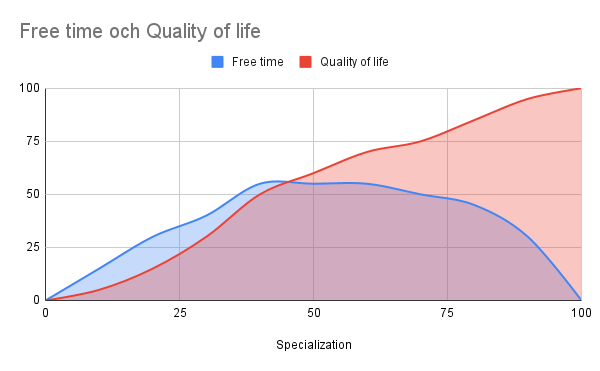 First you gain free time and quality of life, however eventually your free time plateous, but quality of life keeps increasing. The further you go however, the less free time you have. You may have everything you could dream of, but you don't have time live it.
Take a moment to reflect on yourself, your friends and people you know — where they end up on this scale.
That friend that works part time and lives in a small apartment. While they don't spend a lot of time at work, they instead have to spend time cooking their own food with raw ingridents. They have to hand wash their dishes, because they can't afford a dishwasher.
That relative that always drives expensive cars, but never shows up to get-togethers. That old neighbour that is always home, but is always fixing something.
I don't want to be rich
I'm not going to found my own AI start-up. I'm not going to invest in the orphan crushing machine. I'm not going to work weekends to buy a new car.
I'm going to work my 7,5 hours a day, 5 times a week. I'm going to take the bus, so I can spend less time driving. I'm going to live in my house out in the country, where I can thrive.
When I have payed of my mortage, I will probably work 80% instead, I don't want the money,
I'm content. I'm happy.
02-01-2026 -
Why I Left BearBlog
Sigh
This is a hard post to write, because it's pure bait. I'm just to cheap to pay for the 6$ a month. That's it. If you have the cash and want to support the indie web, go ahead and blog there, Herman seems like a great guy.
If you want to blog, but you're as cheap as me, check out this post of mine
30-12-2025 -
On Consumerism
I have started to become dissolusioned with buying new stuff, not just because trying to buy stuff is mostly avoiding scams, but because it doesnt make my life better.
I'm not talking about buying e-waste, but actual "life improving" tools and utiliies. The main problem is that you get used to it, and you just raise the bar on what is normal.
An example
When I was a child, playing Minecraft with my classmates and wasting time on whatever flash game I could find, my older sister got me a cheap headset. Some cheapo plastic headset they use in call-centers, for maybe 15€.
However, I was exctatic. I remember reading the "Optimized for Skype" tagline and thinking "Wow". I was very satified with it, and kept it until it eventually broke after a couple of years.
If I were to use them today, I would probably just avoid using my computer all together. Why? Because I have increased my standard. What was a huge upgrade before, is something that I would need to endure today.
Today, I have entry level studio headphones, and a seperate desktop microphone. I remember when I initially got them (the headphones that is), and was blown away by how much nicer everything sounded — compared to my previous (more expensive!) gaming headset.
I've been keeping my eyes on getting a set of more midrange studio headphones. My friend has a set of open back headphones, which sound excellent, and I've often joked that if he were to die for whatever reason, they'd probably dissapear for unknown reasons.
More seriously though, I've been thinking of buying my own pair, or perhaps even a model higher. It's not a huge amount of money (~200€ range), but I'm starting to get the feeling that it will just increase my standard even more. After just a couple of weeks I wont be any happier. It will be just the same as it is with my current set.
This applies to most aspects of my life. When I was a teenager, I would gladly drink the same percolated, slightly burned and microwaved coffee that my mother drank. Today I a wide array of coffee makers and knowledge to use them. The coffee I make is a lot better now than what I drank as a teenager. Does that make me happier? I was content with that coffee back then, it's just my standard that is higher today.
On consuming
I have always looked down on people buying e-waste, or just waste in general. I had a friend in my late teens, let's call him Billy, who had quite permissive parents, and generally lacked self restraint when it came to burning money.
I remember being over at Billy's place, and being overwhelmed with the amount of stuff he had. For example, Billy had an electric gutiar with an amplifier, a dj table, a huge union jack on the wall (neither of us are british), a elgato streamdeck, etc, etc.
I don't doubt that he made an earnest attempt to use these things, however it was quite evident that they very quickly became dust collectors. Once in a blue moon, he'd pickup his guitar, try to play some famous song, get frustrated at the lack of progress and put it back in his closset.
I started to look down on this behaviour. I quickly learned how easily things become dust collectors, and generally avoided buying stuff that I new would eventually end up like that.
This was my view on consumerism. Mindless consumption of what just ends up as waste. Unlike me and my fellow intelectuals who understood that buying quality is superiour to buying quantity
On consuming quality
I have this other friend, let's call him Jimmy. He is basically the mirror image of Billy. While Billy had a permissive and lenient upbrining, Jimmy had rough and tumoltious one.
Jimmy, today a young adult with a disposable income, only buys things that he actually uses. He is the friend with the open back studio headphones. However, it with him I've found the second fallacy.
Jimmy has bought an expensive OLED gaming monitor for 1200€ (it's down to 700€ now, ouch), and recently upgraded to a RTX5080 (from a RTX4070). Jimmy justifies this as he does spend a lot of his time gaming, of course he should invest in it. Unlike Billy, he actually uses all of his equipment.
He often encourages me to buy the same stuff, giving recommendations on what is good value at the moment. I can't disagree that his setup is more impressive and immersive than mine. Being able to walk around in the pitch dark, with it actually being pitch dark is amazing, especially at 200+fps.
The thing is just... I'm content with my current setup. Sure, getting more FPS in my weekly gaming sessions would be nice, but it wouldn't take long for that to become the standard again.
I did admittedly recently ugrade my setup, though in my defence my previous setup was getting old, and my new is 3,5 times faster. I will also probably get a new GPU soon, not because I think it will make me happier, but because my current one is starting to become actively detrimental.
Where does that leave us?
I don't really know. I'm just a 20-something year old, I don't have the answers to life and happiness. I guess simply beig aware of these two falacies are a good start.
- Don't buy something just because you want it, make sure that you actually will use it enough to warrant it.
- Don't upgrade something unless what you currently use is actively problematic. If you are content with what you have, then you will also eventually be just content with what you upgrade to.
I don't however want this to sound like a push towards asceticism. Some things will make your life better, and you should buy them. I know I keep harping on about studio headphones, but they really made music listening more enjoyable.
Among audiophiles, it seems to be called "critical listening", so my current theory is that you should buy things that:
- You will use
- Will improve something you are less than content with
- Or open a new avenue for doing something new (practice a hobby, consume media in some other way)
Go ahead and get yourself that new OLED TV if you want to enjoy movies in a more critical sense, though avoid it if you're just going to binge Friends untill you fall asleep.
Head to the local market and buy some meaningful handmade crafts. Don't just buy whatever mass produced art get's recommended in your feed.
Buy that fermenting vessel if you want to get started home brewing. A simple 50€ bucket + starter kit will do, upgrade first when that is not enough.
Fix your problems, but not pre-emptively. If you don't have any problems, try finding new ones instead.
15-12-2025 -
Why the fuck do I have FOMO for this?
To start with, I'm quite a fan of paradox games (as in the company, not the concept), with thousands of hours among their games. Recently they released Europa Universalis V, and while skeptical before release it seems to have gotten good ratings and it seems to be relatively stable. I feel like I need to buy it now until it's too late.
But like, why?
If you don't know paradox that well, they tend to release roughly yearly DLCs for their games. This can cause the cost for the "Full game" to bloat into the hundreds, (though I want to note that you still have access to the base game, you don't lose access to content just because they release more content as a dlc. However that discussion is for another post). Long story short, EU V is currently in it's worst state, and most expensive as it will ever be. For every year that goes, there will be free updates for every paid dlc, plus better and better sales. Why do I feel like I need it now? It's not like I have the time nor money at the moment anyway.
I'm going to (try to) do the reasonable thing and wait. Wait for work to calm done, wait for my wallet to recover from christmas (plus some other recent one time purchases), and wait for EU V to get better. Sure, it's probably quite good now, but it's only going to get better.
Let's see how long I can hold on to this...
08-12-2025 -
I am done waiting
Response to Waiting for... nothing?
Waiting for life to start
I relate quite a bit to the referenced post. After I got my first full time job, when my studies where winding down, I started asking my self the question "What now?". I got a chunk of cash each month and was still living at my parents — it felt like something was supposed to happen.
Eventually I met a girl that and we moved together so now I had a use for my monthly paycheck, but it still felt like I was waiting for the real life to start. We eventually moved to another, larger and nicer apartment, quite liberating but still felt like I was waiting for life to start.
Then I found a house for sale in the area where I grew up, for a very reasonable price (it's out in the middle of nowhere), and eventually I signed the papers. Now as a house owner it feels like I'm no longer waiting.
I can now invest into my home, where I will spend most (maybe all?) of my adult life. I can buy furniture that fits the aesthetics without worrying about how it will look in my next home. I was able to join the local volunteer fire department, since I knew I wasn't going anywhere.
I guess that is what I was waiting for, being able to live like I grew up. Being able to pick a random direction and head out into the woods to ponder. Living a quiet life in a small community, just like I did when I was younger.
"What about me?"
I guess this was just my personal goal, so what does this mean for you. This means that you should take some time to ponder what you want your life to be. Do you want to return to a similar living as it was in your childhood? Do you want to forge a new life in a new place? Do you want to live like your idols (parents, influencers, that old guy down the street).
When you have started to get a grasp of what you want, pursue it. Keep your eyes open for opportunity. Half the part of success is being ready for luck (the other half being just luck).
There is a difference between just waiting, and being prepared.
03-12-2025 -
Our little net
I often yearn for the old web — or atleast what it looks like in my rose-tinted glasses. Back when people uploaded things not for fame or fortune, but simply out of a desire to be heard — a time before AI-generated slop, when everything was made by hand.
The slow net
There are many ways people try to recreate the spirit of the early web. One popular approach is aesthetic: white, bare HTML pages scattered with grainy bitmap images. Another is structural: curated rings of sites, deliberately disconnected from the corporate web. The fediverse, meanwhile, attempts to rebuild the large-scale web — but in the hands of users, not shareholders — removing profit as the primary incentive.
But what I personally crave is the slow net — away from endless scrolling and the constant grasping for my attention. I feel like a resource to be mined: my attention, my opinions, my money. Even many small blogs are trying to sell me something, turning every post into a vehicle for profit.
I want to hear the thoughts of people in all walks of life. I want to see art made by those trying to express something true. I want to play the amateur developer’s janky games. I want to relive the stories born from role-plays. I want people to create — not for clout, clicks, or cash — but simply because they have something to say.
How to solve this
I don't know. There isn't a lack of people expressing themselves, the problem is discovering them. But how do we solve this? Search engines prioritize sites that are SEOmaxxing, aka. the corporate web. There are some services that promise the small web, but I dislike that they are curated by a central entity, often to fit a vibe. There are also some search engines that prioritize the small web, but in my experience they easily get flooded with barren slop.
The only way I see is that we, the people who express ourselves link to each other. If you have a site that you think fits here, then let me know! Send me a mail at bigboismith at proton.me. And if you have something that fits on one of my other pages, still let me know. If you found this post (or any of my other pages) interesting then please link to it from your page!
In practice, I believe we should avoid embedding links in the middle of posts — except for cases like disambiguating terms or acronyms. Instead, let’s follow Wikipedia’s model: end each page with a “Further Reading” section, listing relevant or deeper-dive articles.
As I continue to discover the net, I'm going to share pages that I find thoughtful or interesting in a Further Reading at the bottom of each page (of course assuming I have found something relevant to said page), and you should too.
Further Reading
- How to Be Patient in an Impatient World A great and thoughtful post about how the instant satisfaction of our modern world impacts us. It inspired my search for the old net.
- nownownow The concept of having a single "now" page with your current situation/mindset, fitting neatly between about and contact pages.
- Resurrect the old web A similar post on how to revive the old web
26-09-2025 -
Sharing is Caring
For most people, sharing is easy. Whenever I need to do service on my car, I know multiple garages where I'm welcome to just show up as long as no one else got there first. Most of the people I know are welcome to grab apples from my apple trees if they need.
But when it comes to IT, its a lot harder. I have a little raspberry pi that runs some dockers, servers and such. I could absolutely share it, allowing other people to host their own docker images for fun little hobby projects. It uses only a couple of watts anyway. The question is just, for whom?
Most of the people I know in real life are either not interested in IT, or already have their own setup with everything they need. They are just like me, sitting upon unused resources that could easily be shared.
So who actually needs these resources then? Well, when I was a youngling I would have been very grateful to have access to a server to host my ugly websites, perhaps a Minecraft server, maybe some central server for some programming experiments. But I'm not a youngling anymore.
So if I could somehow share my resources with other young people who want to tinker with a server then that would be great. However, I don't really hang with pre/young teens, believe it or not. And allowing access to my server to anyone on the open internet is a very, very bad idea.
So, how do we solve this? How do we handle discovery and vetting, without allowing bad actors. I don't know. Basically, how could thirteen year old me both find a host and prove that I didn't have any bad intentions to its owner? I would honestly like to know - because solving this would both make it easier and more welcoming to start tinkering with IT, and also make self-hosting more rewarding.
(Yes I know there are multiple services with free tiers that offer hosting, but since they are for profit they are destined to be enshittified, hobbyist self-hosters are the only reliable, charitable option that won't necessarily get enshittified).
If you have a good solution, or if it already exists, let me know. Make a blog post or just mail me at bigboismith at proton dot me.
For example, I am running out of hard drive space, but I don't have any more space in my case for another drive. I would be grateful if I could of-load some archival >200GB to some over underused NAS.
26-09-2025 -
Concise Is Good
In school, we were taught to write long — because kids need to learn how to explain things clearly, even to someone who doesn’t care about the topic.
But it seems some people never outgrew this. They think stuffing their opinions into multiple paragraphs — with headers, footnotes, and “just in case” context — makes their ideas seem smarter or more accessible.
Remember that I (and most other people on the net) have a short attention span, and if I am greeted by a long wall of text I'll probably click off. Being able to express meaningful ideas concisely is a quality of its own :)
Further Reading
- you are an absolute loser if you use AI to write your blog post A concise post about using AI for blogging, with a leading story, background, argument and conclusion in just four paragraph and 225 words!
23-09-2025